
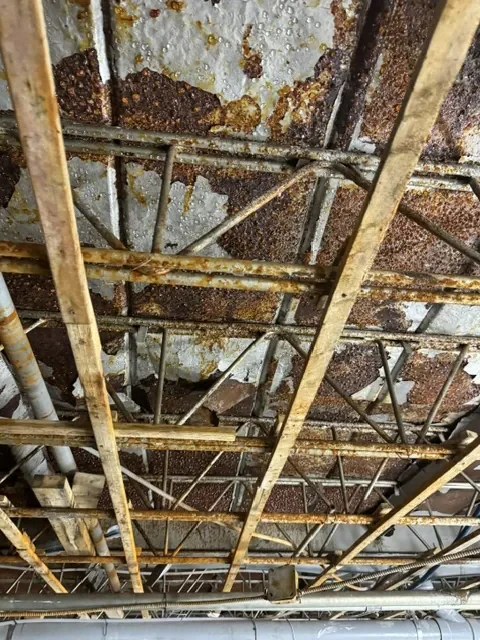
The photo above is what a steel roof deck looks like when it has been left too long. The white paint has let go in sheets, the deck behind it is scaled with rust, and the joists underneath are going the same way. From the floor it mostly shows up as flakes on the racking and rust coloured drips after a cold night. By the time someone gets a lift up there for a proper look, it tends to be worse than anyone expected.
How a ceiling gets like this
Steel deck rusts from moisture, and inside a building that usually means one of three things. Warm, humid air rises, meets a cold roof and condenses on the underside of the deck, night after night through the winter. A roof leak wets the same spot for years. Or the building holds a process that puts moisture or chemicals in the air: washdown areas, plating, food production, pools, salt storage. The original paint was thin and was never meant to stand up to that. Once it cracks, water gets behind it and the rust spreads under paint that still looks fine from below.
Why painting over it does not work
New paint sticks to whatever is on the surface. If that is loose rust and old paint that has already let go of the steel, the new coat comes down with it, usually within a couple of seasons. Scraping and wire brushing knock off what is loose and polish what is left, which is not the same as clean steel. We went through the reasons in sandblasting before painting, and overhead steel is where it matters most, because nobody wants to pay for the lifts, the containment and the downtime twice.
How the steel gets blasted overhead
The blasting itself is the easy part. Everything around it is the job.
Access. The work is done from scissor lifts or boom lifts, a bay at a time. Joists, bridging, conduit and sprinkler lines all sit in front of the deck, so the nozzle has to come at it from several angles to reach the back of every member.
Containment. Whatever comes off the ceiling lands on whatever is under it. The section being worked is curtained off, the floor is covered, and anything that cannot move is wrapped. Lights, sprinkler heads, sensors and electrical gear in the work area are protected before blasting starts.
Wet or dry. Dustless blasting keeps the dust down with water, which is usually the better choice in an occupied building, but water overhead has to go somewhere, so it is planned for. Where water is not acceptable, the steel is blasted dry inside tighter containment. Dry ice is the wrong tool for this one: it cleans without abrading, so it will not remove rust or leave the profile a primer needs.
Old paint. Coatings on older buildings can contain lead. That gets tested before any quote is final, because it changes how the work is contained and how the waste is handled.
What blasting shows you
Rust takes up more room than the steel it came from, so a deck can look solid until the scale is off. Blasting sometimes uncovers pitting, thin spots or holes right through the sheet. That is a good thing to find out, and it is better found before the coating goes on than after. Where a section is too far gone, replacing it is a call for your engineer or roofer. We stop, show you what is there, and carry on with the rest once there is a plan.
Coated the same day
Bare steel in a damp building starts to rust again within hours. So overhead work is done in sections sized to what can be primed before the end of the shift: blast a bay, blow it down, prime it, move on. If your painter is doing the coating, we plan the sections with them. The same approach is how we work in buildings that cannot close, which we covered in blasting on a live site.
One more thing worth saying plainly: if the moisture that caused the rust is still there, the new coating is on a clock too. Fix the leak or the ventilation first, or at least at the same time.
Common questions
Can you paint over a rusted steel roof deck without blasting it?
Not if you want it to last. Paint only holds as well as whatever is underneath it, and loose rust and old flaking paint let go and take the new coat with them. The deck has to be taken back to clean, sound steel with a profile the primer can grip, and then coated the same day.
Can the building stay open while the overhead steel is blasted?
Usually, yes, in sections. The area under the work is closed off and contained, stock and equipment are moved or covered, and the work is scheduled around shifts, nights or weekends. Which sections can run when is worked out on a site visit before the quote.
If you have a ceiling like the one in the photo anywhere in Toronto or the GTA, send a few pictures through the quote form or call (416) 930-1350. Tell us roughly how big the area is, how high the deck is, and what runs underneath it.