A painter gets called back to a railing, a trailer, a set of trusses or a tank that was coated eighteen months ago. The paint is lifting in sheets and there is rust under every sheet. The paint gets blamed, the painter gets blamed, and the actual cause is sitting underneath: the steel was never blasted, so the coating was stuck to whatever was on the surface instead of to the steel.
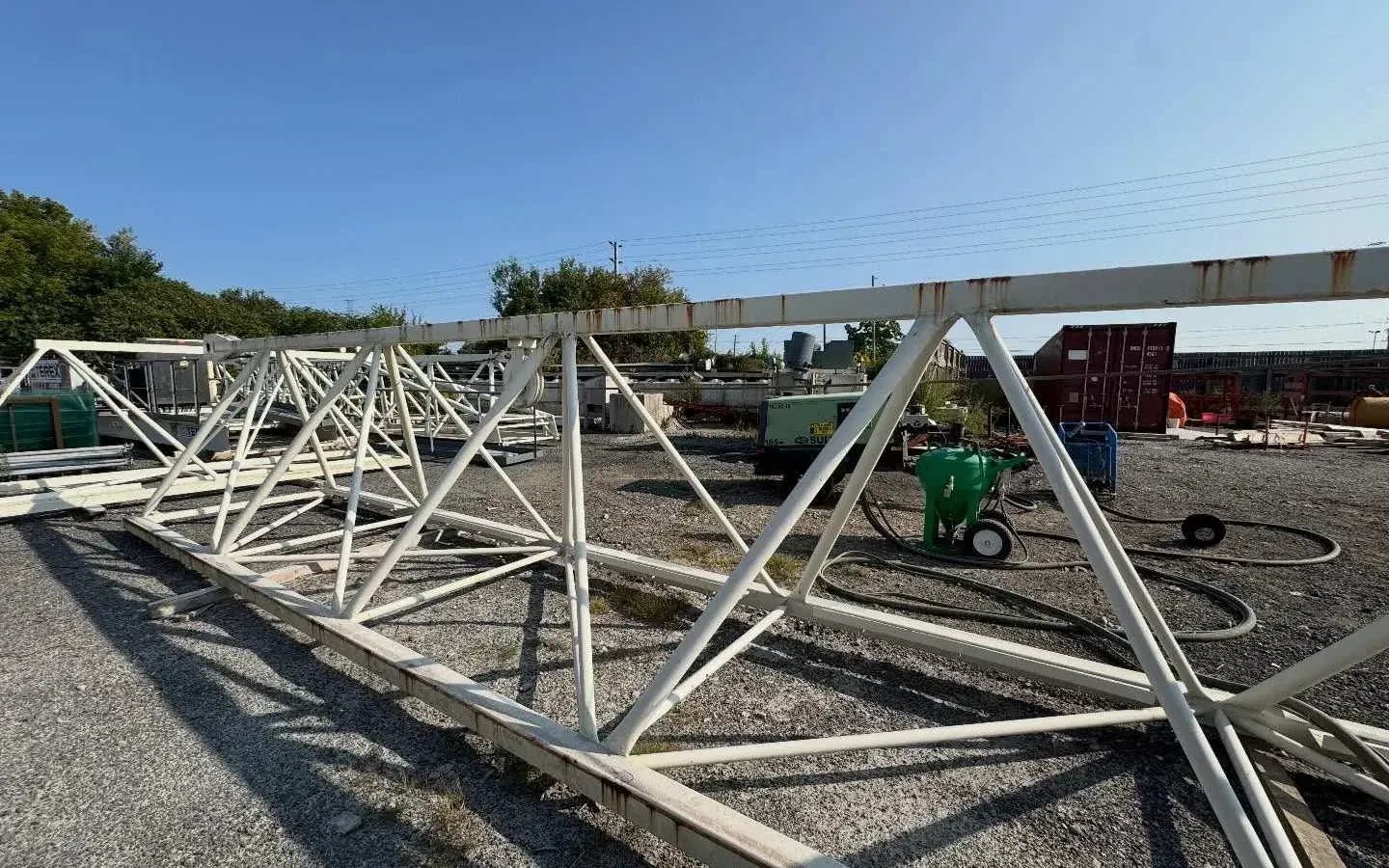
The trusses in the photo are what properly prepared steel looks like. Clean metal, a uniform matte finish from the blast, nothing left on the surface for the primer to argue with. That is the condition every industrial coating data sheet assumes, and it is the part that gets skipped when a job is quoted as "clean and paint".
What a coating actually needs
Clean metal. Mill scale, old paint, rust, oil and salt all have to come off. Not thinned out, off. A coating applied over mill scale will hold until the scale lets go of the steel, and it always lets go eventually, usually once water gets in at an edge.
A profile. Blasting leaves the steel with a fine, even roughness, measured in mils. Most industrial primers want somewhere around 1.5 to 3 mils of profile, and the data sheet will say exactly what. That roughness is what the coating grips. Smooth steel, including steel that was ground or wire wheeled bright, gives the paint nothing to hold and the bond is mechanical in name only.
A surface that is still clean when the paint arrives. This is the one that gets lost between trades. Bare steel starts to flash rust within hours in damp air. Blast on Friday, paint on Tuesday, and you have primed over a new layer of rust.
Why wire wheels and pressure washers are not enough
A wire wheel polishes the high spots and burnishes rust into the low spots. It leaves a shiny surface with no profile and plenty of contamination in the pits. Pressure washing gets loose material and dirt off, which is useful, but it does nothing to mill scale or sound old paint, and it leaves the steel wet. Both are fine ways to prepare for a quick cosmetic touch-up. Neither is surface preparation for a coating that is supposed to last ten years on a structure outdoors.
The standards the coating industry uses make the distinction plain. Hand and power tool cleaning sit at the bottom. Commercial blast, often specified as SSPC-SP 6, is where most industrial repaints start. Near-white blast, SSPC-SP 10, is what tanks, immersion service and high-performance coatings call for. If a coating spec names one of these, there is no way to reach it without blasting.
Wet abrasive, and keeping the window open
Our dustless sandblasting runs water through the abrasive stream, which keeps the dust down enough to work on occupied sites and next to other trades. We wrote up how that compares to dry blasting in dustless vs. traditional sandblasting. On a paint prep job the water brings one more thing: we add a rust inhibitor to it, so the bare steel holds clean for a few days rather than a few hours. That is the difference between a painter who has to follow us around the yard and a painter who can show up Monday.
It also means the surface is rinsed as it is blasted. Chlorides from road salt, which are the usual reason a repainted trailer or a steel structure near the lake fails early, come off with the water instead of being driven into the profile by dry media.
Why this is an October conversation
Coatings have a temperature floor. Most industrial primers and topcoats want the steel above 10 degrees and at least 3 degrees above the dew point, and they want it to stay there while they cure. In the GTA that window closes somewhere in November. A structure, a fleet or a set of equipment that gets blasted in October can be coated and cured before the first hard frost. The same job in December means a heated enclosure, which doubles the cost, or it means the blasted steel sits bare all winter and the whole thing gets done again in April.
If something on your site needs a coating before winter, the blasting has to be booked now, and the painter has to be lined up to follow within the inhibitor window. We will coordinate the dates with whoever is doing the coating so the two do not drift apart.
What gets blasted for paint prep
Structural steel, heavy equipment and attachments, trailers and truck frames, tanks inside and out, railings and gates, roof trusses and joists, pipe and pipe racks, and the steel skeleton of a building that is getting recoated. The rig comes to the site, so the steel stays where it is.
When blasting is too much for the surface, thin sheet, a machined face, or something that cannot take any media, laser rust and paint removal gets it clean without a profile, and we will tell you when that is the better fit.
What to send for a quote
Photos of the steel, close enough to show what is on it, a rough square footage or a count, the coating spec if there is one, and the date the painter is booked. With that we can give you a price, a surface standard and a date that lines up with the coating, in one message.
Common questions
Do I really need to sandblast before painting steel?
For anything industrial, structural or outdoors, yes. Paint bonds to clean metal with a profile, not to mill scale, old coating or rust. Wire wheeling and pressure washing leave all three behind, which is why a repaint over them starts lifting within a season or two.
How soon after blasting does the steel need to be painted?
Bare steel starts to flash rust within hours in humid air. The usual rule is prime the same day, and sooner if it is damp. On wet abrasive jobs we add a rust inhibitor to the water, which holds the surface clean for a few days and gives the painter a realistic window.
Can you still blast and paint in the fall?
Yes, but the window closes fast. Most industrial coatings want the steel above 10 degrees and at least 3 degrees above the dew point, and no frost overnight. In the GTA that generally means getting the blasting done in October and the coating on before the November cold snaps. After that it is a heated enclosure or a spring job.
Got steel that needs a coating before winter, call (416) 930-1350 or send photos through the quote form. We will give you a surface standard, a price and a date that works with your painter.