
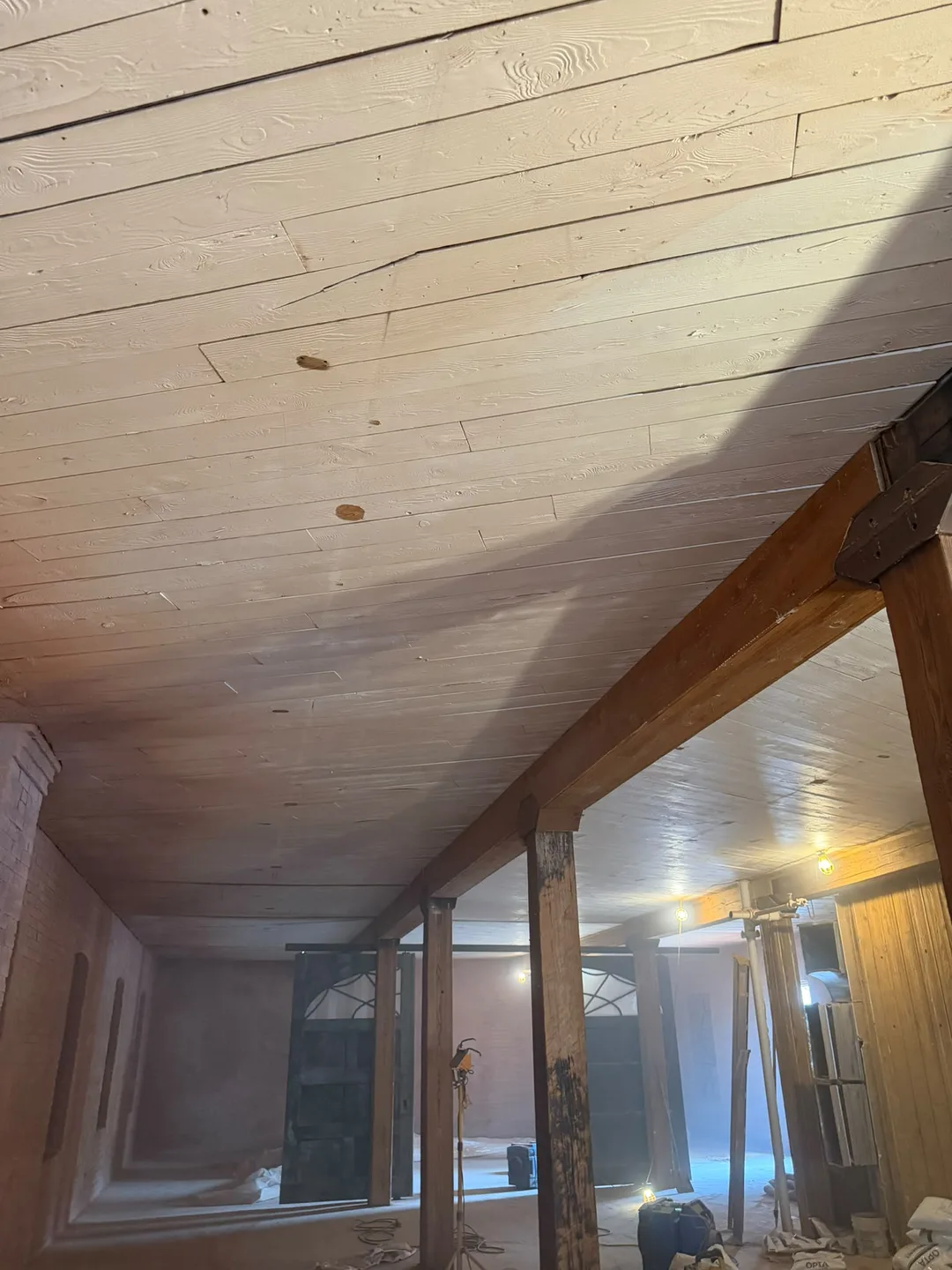
The ceiling in the photo is in a heritage storefront in Toronto. When we walked in, the planks, the beams and the brick were all the same colour, because at some point in the last hundred years somebody painted the whole room and then somebody else painted it again. The owner wanted the building back. Brick is the part people ask about first, and we wrote up brick and masonry paint removal on its own. This post is about the wood, because timber is the part that goes wrong when the wrong crew does it.
Wood is not steel, and it cannot be blasted like steel
Steel is hard all the way through. Wood is not. Every growth ring has a soft band and a hard band, and an aggressive abrasive at full pressure eats the soft band and leaves the hard one standing. Do that to a beam and you get deep ridges, rounded edges and a surface that looks like driftwood. Some people want that look on a feature wall. Nobody wants it by accident on the structure of a hundred year old building.
So the job on timber is to take off the coating and stop. That comes down to three things: a soft media, low pressure, and a test patch before the real work starts. We went through the options in the blast media guide. On wood it is usually soda or walnut shell, which strip paint without cutting, or fine crushed glass turned well down for heavy coatings on dense old timber. The test patch goes somewhere out of sight, and the owner looks at it before we carry on.
What the wood looks like afterward
Clean, pale and slightly textured. The saw marks, the adze marks and the old nail holes are still there, which is the point. The surface has a little more tooth than planed lumber because even a soft media lifts the grain slightly, and the colour is lighter than people expect, since the wood has not seen daylight in decades and has no finish on it yet. It darkens and warms up as soon as it is oiled or sealed.
If the plan is a smooth, furniture-grade finish on the posts, a light sand after blasting gets there quickly because the paint is already gone. On a ceiling twelve feet up, most owners leave the texture as it is.
Where dry ice fits
Dry ice blasting is the other tool for timber. It does not strip thick paint as fast as an abrasive, but it leaves no media behind, it uses no water, and it is very gentle on the surface. It is what we use for soot and char after a fire, for mould on framing, for cleaning unpainted beams that are just dirty, and for wood that has carving, joinery or hardware nobody wants touched. The fire and smoke restoration post shows what it does to blackened joists. On a job with both heavy paint and fine detail, we often use both: abrasive on the planks and beams, dry ice around the parts that need care.
Old paint means containment
Paint in older buildings often contains lead, and a ceiling full of it should not be turned into dust in an occupied building. This is the main reason we run dustless blasting on these jobs. Water in the blast stream keeps the paint and the media from going airborne, and what comes off lands on the floor as damp grit instead of floating through the building. The room is sealed with poly sheeting first, floors and anything staying in the space are covered, and the spent material is collected and bagged at the end. If the building has a paint test or a hazardous materials report, send it with the photos so the containment is planned around it.
Let it dry before it is sealed
Wet blasting puts some moisture into the surface of the wood. It is not much and it does not go deep, but a clear coat or an oil put over damp timber will cloud or peel. The wood needs a few days with air moving through the space, longer in a cold building with no heat on, before any finish goes on. A painter or finisher with a moisture meter can confirm it. Plan that gap into the schedule. It is the step that gets skipped when a tenant is waiting on the space.
Bare timber should not be left unfinished for long either. Once it is dry, a penetrating oil, a clear sealer or a stain keeps it from picking up dirt and handprints. If the building needs a fire-rated coating on exposed timber, that is the architect's or engineer's call, and it goes on over the same clean surface.
The jobs this suits
Warehouse and loft conversions. Post and beam floors with plank ceilings, usually painted white or grey at some point, going back to exposed wood for offices, retail or residential units.
Storefronts and restaurants. Older commercial units where the timber and brick are worth more exposed than covered.
Barn beams and reclaimed timber. Whitewash, old paint and decades of dirt taken off beams that are being reused.
Log homes and cottages. Failed stain and grey, weathered wood taken back to fresh timber before it is restained.
Basements and framing. Joists and beams cleaned up before a basement is finished with an open ceiling.
Why winter is a good time for it
All of this is indoor work. The rig stays on the truck and the hose comes in through a door, so it runs the same in January as in June, and an empty unit between tenants is the easiest site there is. We covered the rest of the cold weather picture in sandblasting in winter. The one thing to arrange is heat in the building, so the wood dries out afterward.
Getting a quote
Send photos of the ceiling and beams, the rough square footage, the ceiling height, the age of the building if you know it, and what is going on the wood afterward. Tell us whether the space is empty or occupied. We work across Toronto, Mississauga and the rest of the GTA, and we will tell you which method suits the wood before we quote it.
Common questions
Will sandblasting damage wood beams?
It will if it is done with the media and pressure meant for steel. On timber we use soft media such as soda or walnut shell, or fine crushed glass at low pressure, and test a small area first. The paint comes off and the beam keeps its shape, its edges and its saw marks. The surface is left with a light texture because the softer grain gives a little, which most owners want and which can be sanded back if they do not.
Is blasting better than sanding or chemical stripper on a timber ceiling?
On a large overhead area, yes. Sanding a plank ceiling by hand misses the gaps, the beam corners and the hardware, and takes weeks. Chemical stripper overhead is slow, messy and soaks into the wood. Blasting reaches into every joint and around every bolt, and a floor that would take a sanding crew a month is usually done in days.
What if the old paint has lead in it?
Paint in older buildings often does, so we treat it that way until a test says otherwise. The area is sealed with containment sheeting, the blast is run wet to keep dust out of the air, and the spent media and paint are collected and bagged for disposal. Tell us the age of the building when you ask for a quote, and if you already have a paint test, send it.
If you have timber under paint and want to know what is under there, call (416) 930-1350 or send photos through the quote form. We can run a test patch so you see the result before you commit to the room.